Quick answer: An ultra-wide lens makes a small room look bigger, but it also stretches furniture at the edges and warps straight lines, so buyers arrive expecting a room that doesn’t exist. In New York, where licensees must run advertising that is an “honest and accurate depiction of the property,” that’s more than a bad first impression. The better approach is a moderate wide angle, a camera placed deliberately, straight verticals and a few well-chosen angles that show what the space actually is. Small doesn’t have to look cramped; it has to look true.
Why small NYC apartments tempt photographers to over-wide
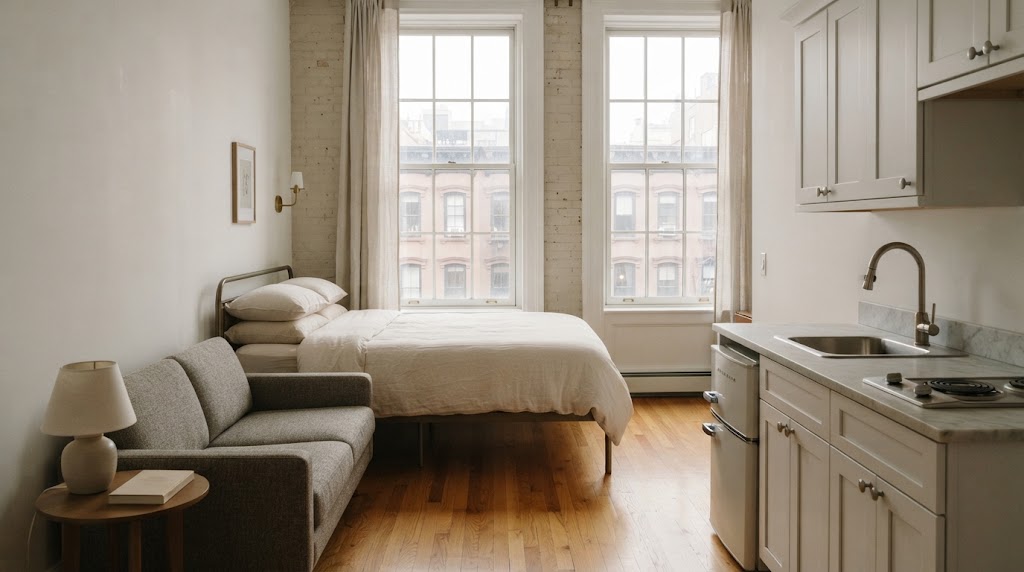
A 400-square-foot studio is hard to photograph. You can barely step back, the camera is often one wall away from the subject, and a standard lens only catches a slice of the room. The shortcut is to go ultra-wide: suddenly the whole room fits in one frame, and the space looks generous.
That’s especially common in NYC, where so much of the inventory is studios, one-bedrooms and prewar layouts with narrow hallways and little floor area. The more small units a market has, the more the pressure to make them look larger.
What a wide-angle lens does to a room
Stepping back isn’t the only way a wide lens “makes room.” It also changes how the room is drawn.
- Objects near the edges stretch. Furniture, doors and people at the edges of an ultra-wide frame look pulled outward.
- Straight lines curve or lean. HomeJab, a real estate media company, says that below about 14mm on a full-frame camera, straight lines in walls, doors and furniture begin to curve, and that the effect is most noticeable in small rooms and tight hallways.
- Depth is exaggerated. Things closest to the lens look much larger than things farther away, so a bed in the foreground can look enormous and a back wall can look miles away.
Those are the properties photographers use to make a room look bigger. They’re also the properties that make the photo untrue. (HomeJab sells photography services, so treat its focal-length figures as one vendor’s view rather than a standard.)
The trust problem: what buyers feel at the door
When photos promise more than the room delivers, the buyer feels it within seconds of walking in. The bed is smaller than it looked. The “spacious” living area is a few steps across. Even if the listing is accurate on paper, the photos have set an expectation the room can’t meet.
HomeJab argues that over-exaggerating a space can lead to disappointment during in-person showings, and that clear, accurate images prevent feelings of being misled. That’s a reasonable expectation, though it’s an argument rather than a measured result. For an agent, the practical cost is easy to see: a showing that goes nowhere, and a buyer who now trusts the listing, and maybe the agent, a little less.
What New York’s rules say
Honest photography isn’t just good manners in New York. It’s connected to rules for licensees.
- New York Department of State. In a November 2025 alert on AI-generated listing images, the DOS reminded licensees that under 19 NYCRR §175.25(c)(9) advertisements must include “an honest and accurate depiction of the property being sold or leased,” and that dishonest or misleading advertising can lead to discipline under Real Property Law §441-c. Its separate advertising guidance says advertising “must be presented in an honest and accurate manner” and includes appropriate photography.
- NAR Code of Ethics. Standard of Practice 12-10 prohibits misleading consumers, including use of misleading images. A REALTORS® association summary notes that “excessive use of photo altering techniques or extreme distortion of a space’s size in a photograph” may mislead consumers.
- OneKey MLS. Its listing rules include not using misleading photos that misrepresent the property.
To be precise: the DOS alert is about AI-generated images and none of these sources set a legal limit on lens focal length. But the principle they share, that photos must honestly represent the property, is the one over-wide shooting puts at risk. This isn’t legal advice; check the sources and your brokerage’s policy.
How to shoot a small apartment honestly
Honest doesn’t mean cramped. These are the techniques that make a small space look good without lying about it.
- Use a moderate wide angle, not the widest lens you own. Pick the focal length by what the room needs, not by what makes it look biggest.
- Shoot from a corner, at chest height. A corner position shows the room’s real shape and lets you keep the camera level.
- Keep verticals vertical. Tilt the camera down and walls lean in. Keep it level and correct perspective in editing so doors and windows stand straight.
- Keep important furniture away from the frame edges, where stretching shows up first.
- Show the room from two angles. One wide, one reverse. Together they communicate size better than one distorted frame.
- Declutter and light well. A tidy room with bright, even light reads as bigger without any lens trick. Natural light and well-balanced HDR do more than extra width.
- Add context shots. A shot of the building entrance, the window view, or the kitchen counter tells a buyer more than a fish-eyed bedroom.
- Support the photos with a floor plan and a tour. Measurements and a walkthrough let buyers judge size themselves. Our packages include both at higher tiers.
How Team PicPros shoots small units
Here’s what our website states: every image is HDR-processed, color-corrected and perspective-corrected and delivered within 24 hours, and galleries come pre-sized for the MLS.
To see what the right approach looks like for your listing, check our premier photography page, add twilight photos for curb appeal, or book a shoot. Planning to add photos to a listing platform? Our guide to MLS photo requirements covers the specs. If aerials are part of the plan, read our guide to NYC drone rules first.
A quick test for your own listing photos
Ask three questions before you publish:
- Do the walls look straight? If doors and windows lean or curve, the lens is too wide or the camera is tilted.
- Does the furniture look the right size? A bed that looks larger than a queen, or a sofa that looks stretched at the frame edge, is a sign of distortion.
- Would a buyer recognize this room at the door? If the honest answer is “not quite,” reshoot or crop.
Frequently Asked Questions
What is the best lens for small apartment photography?
There’s no single best lens, but most photographers recommend a moderate wide angle over the widest option available. HomeJab, for example, suggests 14–16mm on a full-frame camera for larger rooms and a narrower lens in tight spaces for more natural proportions. That’s one vendor’s guidance; the right focal length depends on the room.
Does wide-angle photography make rooms look bigger than they are?
Yes. It stretches objects near the edges and exaggerates depth, which makes a room feel larger than it is. HomeJab notes that straight lines begin to curve below roughly 14mm, and that the effect is most noticeable in small rooms and tight hallways.
Is it illegal to use a wide-angle lens for real estate photos?
Not on its own, and no source I found sets a legal limit on focal length. But New York requires advertising to include an honest and accurate depiction of the property, and dishonest or misleading ads can lead to discipline for licensees. Extreme distortion that misrepresents a space’s size risks falling on the wrong side of that standard. This isn’t legal advice.
What do NAR’s ethics rules say about misleading listing photos?
Standard of Practice 12-10 prohibits misleading consumers, including use of misleading images. An Illinois REALTORS® summary adds that “extreme distortion of a space’s size in a photograph” may mislead consumers and damage the profession’s credibility.
How do you make a studio apartment look good in photos without distortion?
Shoot from a corner at chest height, keep the camera level so verticals stay straight, avoid the widest lens, declutter and use bright, balanced light. Add a second angle and a floor plan so buyers can judge size for themselves.
Does distortion really lose buyers?
It can, though I haven’t seen a measured study. The argument, made by HomeJab, is that exaggerated photos lead to disappointment during in-person showings. The practical risk is a buyer who arrives expecting a bigger room and leaves with less trust in the listing.
Can I use a floor plan to show true size?
Yes. A floor plan gives buyers actual layout and proportions, which photos alone can’t. Team PicPros offers photo plus floor plan packages; book a shoot to add one.